Reconnecting for 2018

It’s the first of January and I’ve just sent my students a Remind message that I’m excited to see them at school tomorrow (and that they should try to get some sleep tonight). So far I’ve received reaction icons ranging from hands clapping to faces frowning.

2018-01-01 16.58.51

The transition back to school after the long break is a tough one. Everyone has forgotten the routines. Days have been spent playing video games and watching Netflix. No one has been going to sleep at their normal time. The first day back will begin much too early.

Here is my plan to get us through this first week:

1. Greet everyone. Greet them by name. Say hi in the hallways and in class. When you walk around the room to see who’s sleeping, check in with each student. At the end of the period or the day, look over your roster. Did you talk to every student? Did you listen to their response? Do this every day for the entire week.

2. Be kinder than necessary. Instead of just “Good morning,” say “I’m glad you’re here.” If the student is receptive (awake), ask about their break. If they’re not, allow them to be silent. Follow up the next day, or the day after. Make it your goal to sit next to every student at some point and ask “How’s it going?” and get an answer in reply.

3. Bring snacks. Share them liberally. The day will be long enough without a growling stomach at 10 am.

4. Ask how much sleep they’ve been getting. Share your own struggles if you stayed up too late and messed up your sleep cycle. Tell your students what you’re going to do to get back on schedule. Remind them every day of the importance of sleep.

5. Practice grace and forgiveness. There are times to be tough and to hold students accountable, and there are times to practice grace. We don’t know what has happened in our students’ lives during the weeks that we’ve been apart. Sure, they might have been eating candy canes and playing video games all night, but we can’t know that, and we shouldn’t assume. It’s our responsibility to be safe and kind and predictable even when our students aren’t.

We must respond to their crankiness with grace and forgiveness. Only after we’ve reconnected will we be able to get back to learning.

Lessons from Star Wars

I write this post immediately upon coming home from seeing the newest movie in the Star Wars franchise: The Last Jedi. It likely comes as a shock to nobody who knows me even modestly well that I’m a giant nerd, especially when it comes to things like fantasy/sci-fi movies, books, religion, and technology. Star Wars encompasses essentially all of that.

But beyond all of that, I’m also an educator, and I’m nearly always thinking of students as they go through their lives as developing humans. And I’m a sucker for a good metaphor.

So as I was watching The Last Jedi, I was thinking about teaching. I’ll keep this spoiler-free, but as is common in these sorts of movies, nearly the entire movie is based around battles. And those battles are often framed for us as good versus evil. Right versus wrong. Light versus dark.

I was getting inspired. I was getting pumped up and thinking of how important it is to be a part of the battle in education. That our students are worth fighting for. That we should be the resistance to oppressive practices and political moves that hurt our students. There was even a thought about battling against students who are tough to teach, but that we can reach them all. Etc., etc., etc.

Then it hit me. The thing that was so inherently wrong with my metaphor and therefore my whole line of thinking.

Teaching is not a battle.

Teaching is not about going toe-to-toe with our students who present us with the most difficulty. It’s not about fighting against those who use practices we believe are incorrect or even harmful. It’s not about fighting for our students. We’re not “on the front lines” or “in the trenches” when we enter into our classrooms.

If that is the case, if we are soldiers in a battle, then who are we fighting against? Are we fighting parents? Students? Administrators? An intangible, general ignorance and passivity?

I can’t reach a student if I view them as an adversary. In my first draft of this post, that was one sentence and then I went on to the next, but I want to pause here for a second to state that again. WE CANNOT REACH OUR STUDENTS IF WE VIEW THEM AS ADVERSARIES. I can name a few students who I have viewed that way, and guess what? I didn’t do a great job of teaching them. The students lost out because of my views.

I do a disservice to the home life of my students if I view their parents as the enemy. Maybe I think their parents are wrong. Maybe they’re overstepping their bounds as parents and telling me what to do as an educator. I have met plenty of parents who I felt were out of line when it came to the education of their child. Who I felt were making poor choices on behalf of their child. I have never met a single parent who makes decisions on behalf of their child that they believe will be detrimental to their child. That being said, I bet parents like that exist. And if you teach their child, then you have to know that that student of yours goes home to those parents. You are with them for a year, or maybe a couple years. They are likely with their parents for decades. We can’t lose sight of that perspective and start painting a picture of the parents as enemies, even if we just think that to ourselves. It’ll inform what we do and how we treat both the parents and the students, and the students will lose out because of our views.

I bring down the entire culture of my building if my administrators are my foes. And I will own that last one: I’ve been there, I’ve done that, and I regret the toxicity I fed into. The adults in the building were fighting, and the students lost out because of our views.

We have to focus on ways to keep it positive. We have to make sure the students succeed and have gains because of our views, not lose out. The “battles” I mention in this post are not bad things to “fight” for. We should be looking for the best for our students. We should promote best practices and be up on the current research. We should be advocates for our students in the political sphere. If parents or administrators are coming to us with things that we think are wrong, we should find ways to address that and be better as a team. It’s not about the things that we might say are worth fighting for. The problem is we shouldn’t be fighting at all. We cannot lift up those in our care if we have to tear someone else down in order to make that happen. We must always be bridge-builders and connectors.

Teaching is about empowering every young person who comes through our doors to be the most well-informed and best person they can be. And there are plenty of metaphors that can help us with understanding the work we do.

Let’s leave the fights and the battles out of it.

The Shamash, The Helper

Shamash2

‘Twas the day after Christmas, and all through the world
All the presents were opened, all the wonders unfurled;
The hugs were all given to those loved so dear,
In hopes that this light and this warmth lasts all year.

As many as two billion people around the world celebrated the Christmas holiday yesterday. Here in the Midwest, it was a beautifully sunny, snow-covered day, reminiscent of childhood holiday seasons. It stirred up the nostalgia in my Christian-raised husband, as he fired up Netflix, searching for “White Christmas”, while I washed out the hot cocoa mugs our family sipped from that evening.

It had already been over a week since my menorah was cleaned of melted wax and placed back in the china cabinet, and the air was cleared of the smell of latkes sizzling in hot oil.

“So, is Chanukah like Jewish Christmas?” asked my dental hygienist a few weeks ago as she scraped and prodded, while I could do nothing more than respond with garbled grunts. Finally sitting upright and all instruments of dental torture out of my mouth, I shared the Reader’s Digest version of the holiday’s history…

Over 2,000 years ago, King Antiochus ruled over the land of Judea, and decided that he wanted all of his subjects to worship Greek gods. The Jews were not down with this plan, as they were a monotheistic people who prayed to one God.  One of those Jews, Judah Maccabee, possibly a Jedi, gathered his fellow resistance fighters, and fought back against Antiochus’s army, pushing them right out of Jerusalem. The Jewish people went right to work cleaning and spiffing up the Temple, restoring it to its original state. They decided to light an oil lamp, but seeing there was only enough oil to last one day, they expected their light to burn briefly…however, the oil continued to burn for eight days! Chanukah, “The Festival of Lights”, is now celebrated to recall this miracle and success over those who wished to oppress them.*
*So, no, Chanukah is not Jewish Christmas.

One of the enduring symbols of Chanukah is the menorah, the nine-branched candelabra which is used to recreate the burning of the oil in the Temple. Chanukah lasts eight days. Each night, a new candle is lit on the menorah, until the 8th night, when the entire thing is ablaze. But, WAIT!!…say my mathematically-minded readers. There are eight nights, but nine branches. That does not add up! Ah, there is, however, a ninth candle, which takes a humble, yet significant role in lighting up the menorah each night.

The Shamash, the ninth candle, is Hebrew for “servant” or “attendant”. It is also informally known as the “helper candle”. On a traditional menorah, the shamash is usually in the middle of the menorah, either taller or shorter than, or set off to the side of, the other 8 branches. The job of the shamash is to kindle the light of the other candles, which then provide a full menorah’s worth of light. The menorah’s light is not meant to serve us, to read or do work by, but to illuminate the darkness, to chase the shadows away.

There is a beautiful sentiment to consider in that the menorah’s light is not created selfishly for us, just as the world was not created for any single one of us. The Earth does not belong to us. We are here to be stewards of this place we call home, maintaining it for everyone else we share it with and for those who have yet to exist. Just as we are caretakers of the Earth, the shamash attends to the lighting of each Chanukah candle. If a candle accidentally flames out, the shamash takes up the task to light it again. One unglorified, plain candle has the ability to bring light to the darkness.

This Chanukah season, after a year of heightened anti-Semitism in the United States, lighting the candles left me pondering the metaphor of the shamash as the candles burned each night in my home.

How can we be a shamash in our teaching lives? How can we kindle the light in others?

With our coworkers, we can be patient, supportive, collaborative, reflective.

With our school’s families, we can be kind, helpful, thoughtful, communicative.

And most importantly, with our students we
Smile
Give them a pencil when they need one
Offer hugs, fist bumps, and high fives
Share a snack when they don’t have one
Talk about their lives and the ever-changing world around them
Show them how to be a good friend
Listen to their stories
Validate their stories
Teach them how to amplify their stories
Introduce them to diverse, life-changing books
Make time for them to read those books
Allow them to wonder, explore, be curious
Tell them they are important and unique
Let them teach
Learn from them

We find it is in the simple acts, the quiet moments, the ordinary interactions that we have the opportunity to be a shamash, a helper, with our children. As teachers, we serve our students best by raising them to be stewards of not only this Earth, but of the people who populate it. When we light that fire in our students, they learn how to become a shamash of their own someday, attending to others for the greater good. It is never too late to kindle a flame, or to rekindle a flame that has extinguished. Once ignited, it may last a day, or eight. Or a lifetime.

Shamash1

Hey! Let’s Try This.

That’s the sentence where the insanity is usually born. Don’t we all start with a crazy idea? It’s what we do with it that counts. Do we keep it buried in our pocket? Or do we take the plunge and dive in?

I took the plunge.

When I began to think about how to spend our time for an upcoming afternoon of professional development, I knew I wanted to keep the focus on teachers. Based on recent observations and teacher feedback, I knew this to be true:

  • Our staff felt we were in a rut.
  • The health and well-being of teachers was being overlooked.
  • Professional development was almost always structured for curriculum purposes.

Most often this time is driven by “data” and does not offer teachers the opportunity to personalize their learning. How many times do we attend PD sessions that are one-size-fits-all? Teachers need choice too. I began to wonder what an afternoon of professional development could look like if teachers had the ability to learn from each other. We are our best resource collectively.

This time of year we are all feeling a bit “frayed” as Tony Keefer talked about in his most recent blog post. He somehow took the juxtaposition of unraveling and gratitude and morphed it into a love letter for teachers. 

On December 8th, just 12 days shy of our winter break, we had our first afternoon of professional learning chosen entirely by, and for, teachers. This day, and all the magic that happened, was a love letter to teaching….and to each other.

Too often in education we get in a rut. Sometimes you have to take an idea and run with it. Don’t be scared to fail. Community is what saves us when things get off track.

Our Reading Lives

“[Kids] don’t remember what you try to teach them. They remember what you are.”

~Jim Henson

As a teacher it’s always been my hope that my students leave my classroom as readers. They may not remember everything we learn about Romeo and Juliet or Twelve Angry Men, but I hope they remember the books they chose to read in class, my excitement about reading, and our classroom reading community. I hope they remember that I care about them.

FullSizeRenderFor six or more years now I’ve been posting covers of the books I read on my classroom door for students and staff to see. It encourages others to read, promotes conversation, and also helps me keep track of what I’m reading (and where I need to fill in genre holes). My students see me reading during SSR and I think it’s beneficial for them to see my reading life as a whole via the covers on my door. They also notice how quickly I’m reading (or not reading).

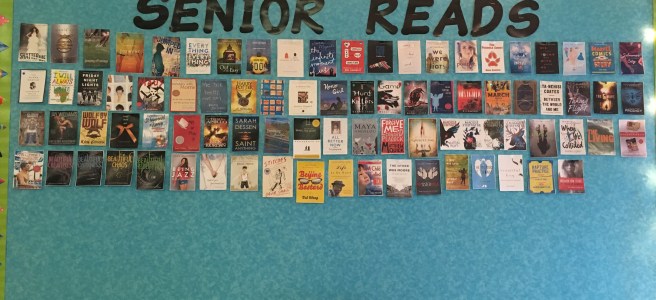
In the past I’ve saved a bulletin board for my seniors to post recommendations for the classes following them. Unfortunately none of my seniors last year participated, so I was left with an empty board this year. After some careful consideration, I decided to dedicate my two bulletin boards to my freshmen and my seniors’ reading lives. It’s fun to create Pinterest-worthy bulletin boards, but 1. I’m not that artsy and 2. I want my students to have ownership in my classroom. So these bulletin boards aren’t “artsy” by any means, but they are effective, which is the whole reason for bulletin boards in the first place.

My classroom now has a space for me, my freshmen classes, and my senior classes to post covers of the books we’ve read. I wasn’t sure what my students would really think of the idea, but they jumped right on board. It’s also prompted some healthy peer pressure between the grade levels. In fact, I just updated my senior board and I heard one of my seniors whisper “Bring it, freshmen!” to another student. Little did he know that I have yet to update my freshmen board! My last group of freshmen walked into class and noticed the updated senior board as well. “I thought we’ve read more than that! They’re ahead by a whole line!” They’re paying attention and the bulletin boards haven’t become “wallpaper” like so many pieces of classroom decor can become.

Since beginning this process, I’ve noticed students looking to the boards to see what everyone has been reading and then asking about specific books they see. It’s also been a great way for me to see the trends in their reading. When a student reads a book that has already been posted, I place a star sticker on the cover. Some books–my book club books in particular–are going to end up swamped with stars! I’ve also been playing around with the idea of including student reviews with the covers as well, but for the sake of space, I’m not sure if that will work. At this point, we may end up posting book covers around the outside of the boards!

The organization has been tricky. I try to carve out time each week to ask my students which books they’ve finished and add it to the list I have for each class. I also have to make time during my planning to insert book cover images onto Google Slides and then ask our media center assistant to print the covers in color. That also means making time to cut out each cover and staple it to the board. It’s an ongoing and somewhat time consuming project, but it’s worthy of my time. I plan on surveying my students at the end of the school year to find out what they think of it and if they think it’s a project I should continue.

I was disappointed when my seniors last year didn’t participate in my former bulletin board practice, but I’m ultimately thankful for it now. This new idea has been much more interactive and successful than any other bulletin board I’ve created. I hope my students continue to enjoy it.

Pushing The Reset Button

A few years ago, it was pretty common to find me pecking at my iPhone playing the game Angry Birds. For some reason, this game had me hooked. As you probably know, Angry Birds is a mobile game where you launch a set of birds from a slingshot and destroy pigs and structures made of rocks. At the end of each level, you can earn up to three stars based on the number of points. Always wanting to improve my Angry Birds proficiency, if I knew that I wasn’t going to earn all three stars at the end of the level, I would quickly stop the level and try again. Essentially, I was pushing the reset button, all the while saving my progress and points I’ve earned so far.
counter-949233_640Each year, I find that winter break is the time when I start to get a bit restless. It’s the half-way point of the school year and a wonderful opportunity for our classroom communities to get together and reflect on all we’ve accomplished.  It’s also a time when we can push that reset button and strategize how we want to move forward.

This week, I asked my students to reflect on the school year and what we have accomplished together so far. I asked them to think of our school year as a video game with winter break being a sign that we’ve made it to a certain checkpoint. We can’t go back to the beginning of the game, but we can start a new level with new strategies and mindset. To start our conversation, I asked students to take a few moments to consider these three questions: What have been the most positive parts of our classroom community that are working well? What parts would you like to change? How do you want to change them?

One idea that has always stuck with me is “how we look back affects how we look forward.” The manner in which we reflect and give feedback will influence how we utilize that feedback and take our next steps. With this idea in mind, I introduced an evaluation tool called a Plus/Delta Chart to help facilitate our discussion.  It’s a simple tool that helps provide continuous improvement for a group or team. I explained that the pluses are working well and what we want to maintain and build upon.  The deltas are opportunities for improvement. These are the things that can be changed so that our classroom culture can become stronger and more effective. The third column is for our prescriptions. This column is where we collectively come up with action steps to change, or cure, our deltas.

After about 10 moments of quiet reflection, we gathered on the carpet to share our thinking. I was anxious to hear what feedback they would offer. I hoped that this would be productive and not a place to complain and criticize.  As the kids talked, I recorded their thoughts. You can see our pluses and deltas below. ** I intended to complete the chart in one day; however due to time constraints, I saved the prescription column for the next day. I feel the prescription column is a vital part of this process, and should not be cut short. I chose to postpone the discussion until the next day since we were running short on time.

IMG_0134
When I zoom out and look at our pluses and deltas, there are a few things that caught my eye.  Many of the pluses come from parts of the day when students have choice–soft starts, writing workshop, book clubs and flexible seating options.  Also, I was intrigued to see that they liked when I stand at the classroom door in the morning. Further evidence that small gestures and simple acts of kindness can be crucial to a strong classroom culture.

When scanning the deltas, it seems like students are very interested in holding each other accountable particularly when it comes to their behavior. I’m thankful for those students who were brave enough to point out these concerns. My hope is that together, we can work through these concerns and strengthen our culture where everyone feels physically and emotionally safe. Without this feedback, this problem could have grown into a larger issue. I am excited to continue this discussion and collectively develop some prescriptions to help cure our deltas.

The first half of the school year can often feel like we are one of those Angry Birds being hurdled through the air at a breakneck pace. Using this winter break as an opportunity to regroup, reorganize and reset has been a healthy step in making sure everyone in our classroom community is heard. This “pushing reset” conversation, aided by the Plus/Delta chart, helped us learn from past mistakes, yet carry optimism into the future.

Acts of Grace and Confidence

unnamed

On the first day of school, I met my student Hiba.  As she stood in our classroom doorway, her first contact with me was a warm, firm hug with the words:

I am Hiba.  Good morning.

Gazing at her, I observed a happy girl wearing a colorful sundress, a beautiful hair bow and the cutest of sandals.  Behind this student’s  big smile and sparkling eyes, was a story, one of grace and confidence. 

“Welcome to our classroom. We are so happy that you are here. ” I replied

I only knew bits and pieces of her story.  Hiba arrived at our school the year before as a  9 year old.  Chronologically, she was old enough for fourth grade, but due to circumstances beyond her control, she was assigned to third grade.  Her placement was not based on language; our school often enrolls children speaking limited or no English.  Hiba’s situation was different; her family fled their home country of Syria when Hiba was a very young child and had lived as refugees for years in Turkey.  Interrupted schooling was an understatement.  Hiba had never been to a formal school and spent her early years folding clothing in a garment factory next to her seamstress mother.   

Regardless of past challenges, Hiba now had a chance to write a new chapter in her story.  She spent her third grade year in our school community  thriving and growing with the support of a loving classroom and caring adults. Hiba was like a very young plant her first year in the United States.  Like a seed, she was absorbing important elements like the culture of school and life in the United States.  As a seedling, she was building the basic language skills that connected her to a new community.  She empowered herself with an understanding school culture.  She made friends, while building her knowledge of life in the United States.  During her third grade year, a team of teachers collaborated with time and care,  helping Hiba build her identity as a reader, writer, and speaker of English. Hiba may have arrived in 4th grade with the label of “pre-functional,” a language learner with a limited English vocabulary, but she came with the confidence and optimistic energy of a student who was ready to work and ready to grow.


My Mission?  Better Yet…Our Mission:

I quickly understood that I could not best serve this child on my own.  I do not speak, read, or write Arabic.  How could I provide experiences for this motivated child and make up for time lost to war, relocation and interrupted schooling?  The task felt daunting and I knew I needed to find a way to move from worry to ease.  Foundational questions helped me discover our collective strengths so both Hiba and I could begin our work together from a place of ease and confidence.  I launched our year together asking:

  • How can my language arts classroom help this child grow?
  • What skills and strengths does this child bring to the classroom?  
  • Who is available to help support this child?

Just like most schools, our ELL teachers and aides have schedules that are stretched in mind-boggling directions.  With great care, the team and I collaborated and  secured a schedule, developing an intentional plan to maximize the talents of our support staff.  Our ELL teacher would provide daily intensive reading support, focusing on reading strategies and vocabulary instruction based on Hiba’s identified strengths and needs. Our bilingual aide would support Hiba’s knowledge of sight words and English vocabulary during writing workshop 3 times a week. With their support steps in place, I planned my role.


My Role:

As Hiba’s classroom teacher, I knew I was responsible for her mainline instruction in language arts, so I prepared my own action plan.  Using Marie Clay’s Observation Survey to gather literacy information about Hiba, I came to know her as a reader and writer during the first weeks of school.  I determined the kinds of sight words, functional words, and cultural vocabulary that would support her literacy development.  

  • During our Reading Workshop, I scheduled a guided reading lesson four days a week with one day to assess her progress, listen to Hiba read a self-selected book, and help her continue to build her own book collection with titles.  
  • I planned daily guided writing lessons for Hiba and other striving writers during Writing Workshop.  I could work closely and support Hiba and a small group of writers showing Hiba that she was not the only one working to become a better writer.  My striving writers learned that they could be teachers and help one another grow in the smaller circle of our guided writing group.  
  • For Word Study, I wanted her to experience our Word Study lessons, but I knew she needed more.  I secured a Rosetta-Stone online account for Hiba to use as an independent study tool to support her English and to enrich her Word Study experiences.

During the first weeks of school, I got to know Hiba just like any other student through “kid-watching” and anecdotal notes.  I watched her handle books and noticed she eagerly asked others to read aloud to her.  I noticed she loved to write and draw elaborate pictures to support her work in her Writer’s Notebook.  She absolutely adored her circle of friends, sweet girls that rallied around Hiba and helped her in any way possible.  Just like a pride of mamma lionesses, each girl took turns making sure that Hiba was happy, included, and successful.  I watched them patiently take time to understand her attempts to be part of conversations at lunch, lessons and workshop experiences.

Hiba demonstrated from Day 1 that she was always observing her classmates, listening to the conversations, and following their actions so she could be an active part of the community. I needed students to authentically enrich Hiba’s learning in a respectful and efficient way by harnessing the social power of our community.

Environment:  I began building supports into the learning environment so that Hiba was guided toward independence.  

  • Seating:  A caring team of friends agreed to sit with Hiba at a table so they could provide support as needed.  I met with the girls and modeled ways to support rather than just “doing” for Hiba.  Their job was to let her be independent and only offer help as requested by Hiba, offering assistance in a kind and respectful manner.
  • Quick Communication Board:  Hiba had access to a clipboard with icons and survival phrases that were presented and explained to her by our Arabic-speaking bilingual aide.  The Quick Communication Board helped Hiba to have dignity and independence when asking for help.  As she felt comfortable with phrases like, “I need to sharpen my pencil”  or “I need to visit the restroom,” new phrases replaced mastered life skills.
  • A Visual Schedule:  Consistency and predictability help children gain control over their lives as they navigate a sea of new language and culture.  Knowing what was going to happen throughout her day helped Hiba to feel secure so her energy was focused on learning.  A buddy or the bilingual aide reviewed our schedule at the start of each day so she knew what was happening at all times.


Workshop Supports:

I looked for intentional ways to capitalize on dignified peer support to help Hiba move towards independence during our literacy workshops.  Thinking about our 3 literacy blocks, I targeted ways that students could enrich Hiba’s membership in our literacy community.

Reading Workshop:  

During Reading Workshop, the freedom to make choices are important to all children, including ELL students.  By adjusting workshop experiences to match Hiba’s growing confidence and skill-set, we launched the year with Book Buddies supporting Hiba in various ways during independent reading time.

  • A Book Buddy listened to Hiba read books from her leveled book tub.
  • Another Book Buddy read a picture book selected by Hiba. The reader not only practiced reading aloud for meaning and fluency, but Hiba grew her reading life and English knowledge with picture books.
  • Audio Books on sources like Epic gave Hiba other independent reading options.
  • Wordless Books were always available for Hiba to read by herself or with others during independent reading time.  The powerful illustrations of these books were later used for vocabulary development during Word Study or 1:1 sessions with an adult.  

Writing Workshop

Hiba met each day for a focused guided writing lesson with me. During Independent Writing Time, Writing Buddies helped Hiba capitalize on labeled visuals.

  • Labeled Pictures:  Hiba would select an image with vocabulary labels to support her writing.  As she crafted a sentence, a writing buddy could read or listen to Hiba and offer support as needed.
  • Visual Dictionary: Peers could target a page in a Visual Dictionary so that Hiba was comfortable using this writing tool to find the words she needed for writing. Students were encouraged to add synonyms to useful pictures.  For example:  on a page with art supplies, a peer added the word “markers” to a caption that read “felt tip markers.”
  • Tech Support:  As Hiba learned to use Google writing tools, spellcheck became an empowering way for her to move closer to conventional spelling.  Those “red squiggles” on misspelled words allowed her to control how she asked for help or corrected words by herself.

Word Study

  • A Word Buddy helped Hiba review vocabulary in her picture dictionary.
  • A Word Buddy listened to her complete Rosetta-Stone lessons so she had an audience for the speaking components.
  • A Word Buddy also served as a vocabulary tour guide around the classroom, checking her understanding of functional life vocabulary cards taped around the classroom.

Lessons Learned

It is natural for classroom teachers to scramble, searching for ways to support and enrich the learning lives of ELL students.  By nature, teachers are experts at designing and controlling experiences for students that lead to positive outcomes.  The lesson I learned from Hiba was one of grace and confidence.  I discovered it was not necessary for me to be the sole provider of her learning experiences.  Rather than looking at a pre-functional student as a daunting challenge for a classroom teacher working alone, support is available when a teacher looks to the strengths of a child and accepts the help of the community.  

With intentional planning, the people in Hiba’s learning community coordinate and maximize learning opportunities.  Teachers and students help Hiba navigate a new language and culture each day in our own way.  As teachers, we cannot control a child’s past experiences or a child’s present level of English language skills.  What we can control is how we respond to this learner.   When we respond with dignity, optimism and the strengths of our community, we find unlimited unlimited powers and opportunities.

More than Nothing

On Saturday, November 18, I had the pleasure of delivering an Ignite talk at NCTE. The following is a modified version of that (with a few extras thrown in as this blog does not come with the same constraints as a 5-minute Ignite talk!).

Before you begin reading the rest of this post, do me a favor. If there’s someone nearby, go to them, smile, and ask them how their day is going. Or tell them you’re glad to see them today. Or give them a small compliment. Or just say hi. If you’re not near anyone, pick up your phone and text someone something nice. I’ll wait.

Did you do it? If yes, continue. If no: I’m serious! Go do the thing. Then continue below.

Okay.

So.

How do you feel? I’m guessing that you feel just ever-so-slightly better than you did a moment ago. Nothing world-changing. Perhaps a similar feeling to a nice sip of a warm coffee or tea. Nothing to write home about, but certainly no worse than you felt before. And there’s a good chance that you feel just a little more connected to the world around you, and just a little better about the day.

But this post does not exist to make you feel good. Frankly, I don’t really care about making you feel good. I mean, I do, but there’s a good chance that, if you’re reading this, you’re an adult. You have ways to manage your own moods and temperaments. You might be reading this blog post for that very reason, as it tends to be a pretty positive place. But if you’re a teacher, you’re probably here for your students. So take a moment, and think about the student who has no choice but to be in your classroom. If you can, think of someone who hasn’t said a word — not a single word! — to you yet this year. I think there are more students like that out there than we may admit or realize.

I posit that having the sorts of brief, positive interactions you just had at the start of this post with your students is beneficial to both you and your students. But that’s sort of obvious, I think. Being kind and positive to your students is good for them? Super ground-breaking news, I know. But the key is it can’t just be once. Or twice. Or when you’re in a good mood. Or when they’re in a good mood.

It has to be every. Single. Day. You have to be hard to ignore. Because if I’m a student, and I want to shut down, I can do that so easily. All I have to do is nothing. Nothing is often the easiest thing to do. It’s simple to default to nothing. It’s easy to make myself invisible. To make myself nothing.

We know this isn’t good! Being nothing, as it turns out, is very bad. And if a student acts like they’re nothing, they will begin to feel — or perhaps already do feel — like they are nothing. And if they feel like they are nothing, then we have failed them, because each and every child who comes into our classroom is someone who has worth. Every child — even if they’re only there for one day — has value. Every child is deserving of celebration and deserving of love.

So you can’t be easy to ignore. Imagine you decide, for example, that you are going to greet every student at the door when they arrive to your room. And you do this for 3 or 4 days, but on the fifth day, your principal is talking with you, and on the sixth day, you’re just not feeling too good because it’s Monday, and on the seventh day you’re there again, but on the eighth day, you just have too much to prepare for the students inside the room that you can’t be at the door, and the ninth day, you stop greeting your students at the door because it’s a lot of work.

Well, guess what? It’s really easy to be a nothing student with a teacher who does that. The first few days, I can just give you the cold shoulder and take my seat. And then there were a couple days where I thought you stopped trying to greet me, so it was easier for me to be nothing. And then there was another day of it, and I thought “oh geez, she’s trying it again,” and then you stopped, and I went on being nothing. And I learned nothing except how to feel like nothing.

The students who think they are nothing need you to show them they are something Every. Single. Day. Because it’s easy to ignore the idea that I am something when I am not confronted by it. But it becomes really hard to continue on the path of believing I am nothing when I have someone who says hi to me every day, with my name, and they are smiling at me, and they say my hair looks nice, and I guess it does, but I walk past them because I don’t care and I don’t want them to care but they say hi to me with my name and a smile every day, asking about me as a person, not just me as a student, and they’ve been doing this for 3 months straight, and don’t they understand that I’m nothing?

Or maybe they know something I don’t. Maybe I’m not nothing. Maybe the reason they say hi to me is because I’m worth saying hi to. Maybe the reason they say they’re glad I’m here is because they’re glad I’m here. Maybe they want me here. Maybe I’m wanted. But who wants nothing? How can I be wanted and be nothing?

Maybe I’m not nothing. I’m not nothing. I’m something. I’m someone. I’m someone, and I’m wanted.

I believe that there is not a teacher out there who wants any of their students to feel like they are nothing. Guess what? YOU have the power to make every single student feel like they are someone. Let me repeat that. You have the power to make every single student feel like they are someone. Feel free to read that again and again until you understand it.

Do you know why you have that power? Because you’re the adult. You chose this profession. You chose to accept the job you’re in. You get to make these sorts of large-scale choices. The student doesn’t get to choose whether or not to come to school. They usually don’t get to choose their teachers. Their choices are limited. They can choose to act like they are nothing.

Also as an adult, you have the emotional maturity to act in ways you might not want to because you know it’s for the betterment of yourself and others. So you are the one who has to make the choice to say hello outside your door, with a smile, every day for 5 months straight to someone who acts like they are nothing and like you are nothing. Your degree is a contract that you will outwait your students. You will treat them like a person longer than they will treat you like not a person.

We have to do this. We have to do this because people who think they are nothing don’t graduate high school. People who don’t graduate high school are three times more likely to be unemployed than those who do. 80% of the incarcerated population in the US are high school dropouts. 70% of African-American males who don’t graduate high school are imprisoned by the time they are 30. We have to do this work.

And we’ve gotta love them all. We have to love the ones that are going to end up in prison, and the ones who love Drake as much as we do. We have to love the students who fail our courses as much as we do the ones who do the extra credit they don’t need because they just love our class that much. We have to love the ones who treat us like garbage as much as we do the ones who pick up the garbage in our classroom because they want to be nice. We MUST make sure EVERYONE who comes into our rooms knows they matter.

Because the student who thinks they’re a nobody? They drop out. And things are not great for those without high school diplomas in our current society. There aren’t the farming or factory jobs there used to be. Minimum wage isn’t enough to survive on, if they can even find those jobs. What often is available and provides enough income to survive on is illegal. There are things we need to address as a society, but we need to focus on what we can do with the students right in front of us.

Because those students who think they’re somebody? They try. They often don’t drop out. It might be hard. It might take them 3, 4, 5 dozen times before they really understand the concept. But if there’s someone who believes in them, they will do it.

So we have to be those people. We have to believe in them. If not us, who? If not now, when? Your students need you, the very day you arrive back in the classroom, to tell them you’re glad they’re there, as Pernille Ripp does with the sign outside her classroom (click the image for her blog post about this sign).

Image via Pernille RippI cannot think of better words to add to that sign, but I will just say this: remember who is more important in the student-teacher relationship. It’s not the person with the name on the door and the degree on the wall. It’s the child whose creations are the reason you ran out of wall space and took your degree down to make room.

Because if you ask yourself who matters more in the student-teacher relationship and the answer is “I matter more than my students,” you will not change the lives of anyone in your care. You are the professional. You are the adult, and they are the still maturing human. For the hours they are in our care, they matter more than us. Their feelings matter more. And it is important they know they matter.

All of our students matter. Every single one — even the one who has only shown up to class 3 times this year. Even the one who might only set foot in your room once. Even the one who would sooner spit in your face than ask or answer a question. Every single student matters. It’s imperative that we help them see that in themselves. Every single day. Until each of them know they are more than nothing.

I Am Thankful For You

Halfway through November, the leftover Halloween candy in the school office still tempted the staff as the realization set in that the holidays were approaching. Thoughts of report cards and running records, defrosting turkeys and holiday shopping ran through our minds simultaneously. Was it really time to plan for the last days of school before Thanksgiving break? How could it be? Didn’t the school year just begin?

Every morning, teachers hit the “go” button, jumping into the usual rush to
write the morning message
run one more copy
check out a library book
track down the tech guy
grade writing pieces
plug in the iPads
drop off papers with teammates
grab the mail
rehearse the day’s minilessons…
But on that Monday morning, our rush came to a stop.

That Monday morning, we arrived at school to learn that one of our middle school students had passed away over the weekend.

He had taken his own life.


Blank space. Because there are no words to adequately fill it.

We stopped. We listened to the news. We stood with our mouths agape, our eyes pooling with tears. He was a young man none of the elementary teachers knew, as he was new to the district this year. According to his mother, he had experienced bullying from a young age, but this loss was a shock to everyone.

As we absorbed the news and struggled to comprehend this horrific reality, there were only questions to fill the heavy silence.

How could this happen?
What will his teachers think?
How will his classmates handle the news?
What else could have been done?

That evening, on a group text with my third grade teammates, we asked each other those very questions. Desperately wanting to dissolve our feelings of helplessness and hopelessness, we asked ourselves a new question:

What can we do now?

Like dry kindling to a newly lit fire, ideas began to spark, bouncing back and forth, until we had a plan. Our response. Our refusal to let this tragedy be unanswered.

Grand scale change always starts with a small act, a kind word, a good idea. “This is what kindness does…Each little thing we do goes out, like a ripple, into the world,” the teacher in Jacqueline Woodson’s book Each Kindness tells her students. How many people have their day changed for the better by a smile, a compliment, a thoughtful word?

This got us thinking…how often our children are told to be grateful for things, yet how rare it is for them to hear that others, especially adults, are grateful for their existence.

Our big plan would be, in practice, a small gesture. A little kindness that we hoped would reverberate within each of our students, perhaps becoming infinitely meaningful to some. We wanted to let each of our children know that we are grateful for their existence.

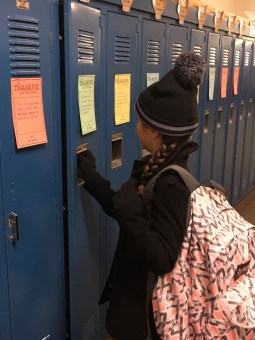
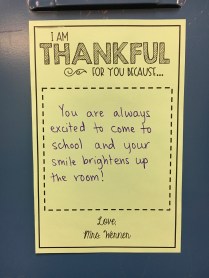
The last day of school before Thanksgiving break, before the children arrived, my team printed out a template that read: “I am THANKFUL for you because…” and wrote a personal note to each of our students. We admired their talents, highlighted their unique personalities, and encouraged them to shine. Like secret kindness ninjas, we hung each note on their lockers and waited for the buses to arrive.

One by one, our 8 and 9 year olds strolled down the hallway, catching glimpses of the notes, and rushing down to their own lockers to see what treasure awaited them.

One by one, they discovered their notes, and stood reading, backpacks dangling from their arms. What followed were
smiles
blushed cheeks
curiosity
amazement
second and third reads
“Thank you Mrs. Werner!”
squeals
hugs
gratitude
ripples of kindness.

At the end of the day, each student carefully peeled his or her note off the locker and took it home with them. I figured some of the notes would be waved excitedly in parents’ faces at home, others silently cherished and saved, and others soon to be lost or forgotten. But what mattered most was that each child got to experience a moment reading words that let them know that we, their teachers, are grateful for each and every one of them.

*****

Back to work Monday morning after a restful break, I leapt into the usual rush once again. Checking my email, I noticed a parent had written one over our break. It read:

“Thank you for your kind words that you wrote on A’s locker. He showed me the note and we proudly displayed it on our fridge.”

In the rush of preparing for a full, busy week, I took a moment to stop and be grateful that my words had a ripple effect on this student. Thanksgiving may have passed, but it is never too late to tell your students directly and sincerely how thankful you are for them. You can never know how deeply that may affect them. It just might send ripples straight through their hearts.

 IMG_3318 IMG_3315

IMG_3298 IMG_3291 IMG_3296

IMG_3311 IMG_3324

Build Your Community

Building a thriving learning community for your students is the fundamental core of this website. The work you are doing to create safe and engaging learning spaces is one of the most important things you do. But, do you take care of yourself and build your community? Finding a community probably saved my teaching career. Adding to my community over the last 18 years helped me to continually develop my practice.

Early in my career and before the age of social media, I felt like I was drowning. The people in the school where I worked were kind and honestly good people, but there were only a few that actually supported my learning. With their help I made it through, but I struggled. Thankfully, I found community within a group of literacy coaches a few years into my career. If it weren’t for these mentors, I might have walked away from teaching before I really got started. Besides being a strong support network this group encouraged me to get involved with the nationwide organizations ASCD (Association for Supervision and Curriculum Design and ILA (International Literacy Association). These nationwide groups connected me with people outside my local community of adult learners by attending conferences by sponsored by these groups.

In this age of social media, it is easier than ever to get connected with other educators. If you are reading this post it is most likely due to seeing a link on Twitter or Facebook. However, this post about building your community is not about widening your online network. While I still use Twitter and Facebook and keep up with educational websites, I work hard to not be ‘plugged in’ every single day. I worry about how social media affects my attitude and how too much time online impacts my day-to-day life. I know that I can quickly lose hours of time I could be doing something more productive very quickly. Working on building my real-life community is becoming more and more important to me. This is why I am a member of NCTE (National Council of Teachers of English) and regularly attend events it sponsors.

Over the past six years, some online connections have turned into real-life connections. When I attend events where these people are, my relationships (and learning) grow stronger. During the recent NCTE Annual Convention in St. Louis, I listened to Brian Wyzlic deliver a passionate speech about ensuring every child you teach feels valued every single day. We also had numerous conversations during various times at the conference. While speech affirmed my thinking, I learned more eating dinner with him and walking through the halls. I have known Brian for about 5 years. We have been around each other for maybe 25 days in those 5 years, but learning with and from Brian in real life has been more profoundly helpful than on Twitter.

I had an incredibly thought-provoking conversation with Kristin McIlhagga on Saturday night. After a long day of learning from some of the best educators on the planet, Kristin pushed my thinking was pushed more than anyone else that day. Like Brian, I have only been around Kristen at events like conferences. And while I do learn from her and am supported by her during online interactions, the face-to-face conversations are what really shift my thinking.

I was honored to present with Justin Stygles, Kara DiBarotolo, Cheryl Mizreny, Michelle Best and Laurie Halse Anderson on Sunday Morning. While I knew what was going to be said when they talked, The subtle nuances of body language and tone of voice made the learning more powerful. Plus, the time we spent together outside the session cemented the fact I am proud to know them. I met Michelle or Laurie at NCTE look forward to connecting with them again in the future. They are both smart and very passionate about their work. Justin, Kara and Cheryl have been go to resources for a while, but we wouldn’t have the relationship we have if it was completely online.

Throughout the entire NCTE convention my actual conversations with other attendees that I have known for years and ones that I just met over the weekend made the cost and the effort to attend worthwhile. I know the VISA bill will suck next month, but I cannot imagine not going next year.  

Real-life professional connections, both local and not-so local, support me and challenge me. The online world is a great place to start, but do whatever it takes to get to places where your online connections meet in real life. The echo-chamber of social media is not necessarily bad, but I think you can only find true support to push your thinking in the real world. Think about your classroom. Would you let your students do a completely computerized curriculum with only random comments of a few sentences provided by you? Probably not. So why would you do it to yourself?

I encourage you to consider building your community by joining an association, either local or national and attending their conferences or other conferences near you. I guarantee it will be worth your time. Below are links to various professional organizations that support educators. They are all designed to help you. They want you to engage in a bigger community.
ACEI, Association for Childhood Education International (www.acei.org)

ACTFL, American Council on the Teaching of Foreign Languages (www.actfl.org)

AECT, Association for Educational Communications and Technology (www.aect.org)

AERA, American Educational Research Association (www.aera.org)

ALAS, Association of Latino Administrators and Superintendents (www.alasedu.net)

AMLE, Association for Middle Level Education (www.amle.org)

ASCD, Association for Supervision and Curriculum Design (www.ascd.org)

ASCA, American School Counselor Association (www.schoolcounselor.org)

CEC, Council for Exceptional Children (www.cec.sped.org)

ILA, International Reading Association (https://www.literacyworldwide.org/)

ISTE, International Society for Technology in Education (www.iste.org)

NAEA, National Art Education Association (www.arteducators.org)

NAESP, National Association of Elementary School Principals (www.naesp.org)

NAEYC, National Association for the Education of Young Children (www.naeyc.org)

NAfME, National Association for Music Education (www.nafme.org)

NAGC, National Association for Gifted Children (www.nagc.org)

NASSP, National Association of Secondary School Principals (www.nassp.org)

NBEA, National Business Education Association (www.nbea.org)

NCSS, National Council for the Social Studies (www.ncss.org)

NCTE, National Council of Teachers of English (www.ncte.org)

NCTM, National Council of Teachers of Mathematics (www.nctm.org)

NSTA, National Science Teachers Association (www.nsta.org)